
雖然這篇Shintoism鄉民發文沒有被收入到精華區:在Shintoism這個話題中,我們另外找到其它相關的精選爆讚文章
在 shintoism產品中有9篇Facebook貼文,粉絲數超過4,471的網紅黃心健 Hsin-Chien Huang,也在其Facebook貼文中提到, #Congratulations! Director Hsin-Chien Huang's latest VR works, Samsara and The Starry Sand Beach, were nominated for the 78th Venice International Fi...
同時也有1部Youtube影片,追蹤數超過147萬的網紅Kento Bento,也在其Youtube影片中提到,Get ‘Asiany’ Merch at our new merch store!: https://standard.tv/kentobento Support us on Patreon: https://patreon.com/kentobento ★ Has McDonald's C...
「shintoism」的推薦目錄
- 關於shintoism 在 MATCHA-PHOTOGENIC JAPAN VIEWS? Instagram 的最讚貼文
- 關於shintoism 在 Marihiko Hara / 原 摩利彦 Instagram 的最佳解答
- 關於shintoism 在 ミカエラ | Fukuoka Japan Travel Instagram 的最佳貼文
- 關於shintoism 在 黃心健 Hsin-Chien Huang Facebook 的精選貼文
- 關於shintoism 在 Marihiko Hara / MH Studio Inc. Facebook 的最讚貼文
- 關於shintoism 在 Firdaus Wong Wai Hung Facebook 的最佳貼文
- 關於shintoism 在 Kento Bento Youtube 的精選貼文
shintoism 在 MATCHA-PHOTOGENIC JAPAN VIEWS? Instagram 的最讚貼文
2021-09-24 01:39:05
Temples and shrines are two of the most common structures you’ll find while visiting Japan. But how do you tell the difference between the two? MATCH...
shintoism 在 Marihiko Hara / 原 摩利彦 Instagram 的最佳解答
2021-04-04 08:52:26
Some tracks by Marihiko Hara featured: OKINA Dance of Life on NHK WORLD May 30, 2020 10:10 - 11:00 / 16:10 - 17:00 / 22:10 - 23:00 May 31, 2020 4:10...
shintoism 在 ミカエラ | Fukuoka Japan Travel Instagram 的最佳貼文
2020-05-09 11:52:43
Niutsuhime Shrine! A welcome pitstop during the long hike along the choishi-michi pilgrimage trail. This Shinto shrine is said to protect the spiritua...
-
shintoism 在 Kento Bento Youtube 的精選貼文
2015-12-23 14:17:26Get ‘Asiany’ Merch at our new merch store!: https://standard.tv/kentobento
Support us on Patreon: https://patreon.com/kentobento
★ Has McDonald's Conquered Asia?: https://youtu.be/pgHiRsk2UjY
★ Where Are The Asian Borders?: https://youtu.be/vPupwlZlNMY
★ 'Asian Eyes' Are More Common Than You Think: https://youtu.be/WxTnVWgOGLc
★ How Would You Escape North Korea? (The 7 Choices): https://youtu.be/6A0ZOkMDLw0
★ 10 Things You Didn’t Know About FUKUSHIMA NUCLEAR DISASTER: https://youtu.be/HpOG4WFKBZQ
★ 10 Things You Didn’t Know About HIROSHIMA ATOMIC BOMBING: https://youtu.be/wETSBaFwzu0
★ 10 Things You Didn’t Know About 2011 JAPANESE TSUNAMI & TOHOKU EARTHQUAKE: https://youtu.be/VuWTETyzR9Y
★ 10 Things You Didn't Know About RAMUNE: https://youtu.be/4boZ1op4Zrs
★ 10 Things You Didn’t Know About NATTO: https://youtu.be/Hyuyk7GJgd8
-----------------------
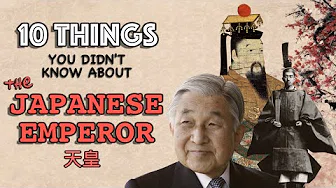
10 THINGS YOU DIDN'T KNOW ABOUT THE JAPANESE EMPEROR 天皇
Just prior to Christmas, on the 23rd of December, it is the current Japanese Emperor, Akihito’s birthday. It is a national holiday in Japan (天皇誕生日).
1) WORLD'S OLDEST MONARCHY
The Japanese monarchy, The Imperial House of Japan, is the oldest, continuous hereditary monarchy in the world.
Compared to other monarchies, you have the British Monarchy starting at 1066 and the the Danish Monarchy at 935. For the Japanese Monarchy, we’re going back to 660BC, which started with the legendary Japanese Emperor Jimmu.
2) DESCENDENT OF GODS
Shinto is the largest religion in Japan, and the line of Japanese Emperors are said to be the direct descendants of several Shinto gods, the most notable being the Sun goddess, Amaterasu.
The Emperor is the ceremonial head of state in Japan, but it makes sense that with his divine ancestry, he is also officially the head of the Shinto religion itself.
3) TERRITORY-INDEPENDENT PHENOMENON
As odd as it may seem, the title of Emperor (or Tennō) has never really been about territorial designations. Contrast this with European monarchs who often wanted to conquer and control additional territory.
In fact, the position of Emperor is a territory-independent phenomenon. In other words, the Emperor is the Emperor regardless if he has followers in the whole of Japan or in only one province.
4) EMPEROR'S CAPACITY
From 1192 to 1867, the shoguns held the real power (Shoguns being the military commanders of the time). The Emperor still officially nominated the Shoguns to their positions, but this was largely ceremonial.
Today, the Japanese Constitution vests executive power in the Prime Minister and his Cabinet.
5) POLYGAMY
The Japanese imperial dynasty consistently practiced official polygamy.
Besides his empress, the Emperor could take several secondary consorts or concubines; which helped produce more offspring for the imperial clan
6) FIRST COMMONER WIFE
In the history of the Japanese Imperial Family, there was never an Emperor who had a commoner as wife or even concubine. That is, until now.
The current Emperor of Japan married Empress Michiko, a commoner! She was not from the former court nobility nor from one of the former branches of the Imperial Family. Michiko was the daughter of an industrialist
7) FISH SCIENCE
(Ichthyology = Fish Science)
The Emperor is a published ichthyological researcher, having written papers for several scholarly journals, and has specialised studies within the taxonomy of the family Gobiidae. Random
8) STOP GAP EMPRESSES
Generally, it has been males who have ascended Japan’s Chrysanthemum Throne. However, if a suitable male was not available, there have been times where women have ascended the throne; almost as a stop gap measure.
Of the 125 monarchs, there have been 8 women who have reigned on 10 different occasions. 2 of them reigned twice.
Once a suitable male descendant was considered old enough to rule, many Empresses, and even Emperors, abdicated or relinquished the throne
9) CHILD EMPERORS
Over a thousand years ago, a tradition started that an Emperor should ascend young. If he had passed his toddler years, he was said to be old enough. Being a child was apparently a fine property
10) ABDICATING TREND
Abdication was very common. Actually it was more frequent than death on the throne. The Emperors tasks involved so many repetitive rituals that after about ten years of service, it was deemed a reasonable compensation to live the rest of their lives in pampered retirement!
----------------------
ABOUT
We do videos on interesting 'Asiany' topics - Asian stereotypes, Asian pop culture, Asian issues, Asian history, AMWF, and things you just didn't know about Asia!
TEAM KENTO BENTO
► Script, Narration & Editing by Kento Bento
► Artwork by Nina Bento
► Interested in working with us? Get in touch now!
*** If you're interesting in being a contributor for Kento Bento, let us know what you would like to do (research, video editing, etc) & we can figure something out together!![post-title]()

shintoism 在 黃心健 Hsin-Chien Huang Facebook 的精選貼文
#Congratulations! Director Hsin-Chien Huang's latest VR works, Samsara and The Starry Sand Beach, were nominated for the 78th Venice International Film Festival!
The 78th Venice International Film Festival (VIFF) announced the shortlisted nominees for the category of VR Film. Taiwanese new media artist, Distinguished Professor of NTNU, Hsin-Chien Huang, winner of the BEST VR Experience in 2017 with his work La Camera Insabbiata, will again contest for the Leone d’oro this year with two of his latest, sci-fi inspired works, Samsara and The Starry Sand Beach. While the Taiwanese athletes are striving for the Gold Medals at the Tokyo Olympics as we speak, director Hsin-Chien Huang dazzles the jury of VIFF with his visually-stunning and thought-provoking works — bringing cutting-edge Taiwanese VR films onto the international stage and letting world-wide audience sees Taiwan!
Before being selected for the 78th Venice International Film Festival, Samsara episode 1. has already grabbed the Jury Award at SXSW and Best VR Story at the Cannes XR Competition. This futuristic VR experience teleports the audience onto a journey that spans millions of years. Samsara is a Sanskrit word meaning “ the world ”. In Buddhism, it means what we perceive as the world is actually an endless cycle of karma (cause and effect), a cycle of life, death and rebirth in the six realms of existence. In this fascinating VR work, the audience is reincarnated into the bodies of different persons and creatures, experiencing the universe in their new bodies and in search for the ultimate spiritual transcendence.
Samsara depicts an apocalyptical story in the near future where human greed has depleted the earth’s resource. Catastrophic wars to fight for resource resulted in global destruction. Finally, the remaining humans had to leave the Earth and go on a search in space for a new place to live.
Nevertheless, their desperate, long quest for a new homeland… could it be just a loop in space and time? The cycle of greedy domination and total destruction that then necessitates the search for a new home…. may have hopelessly repeated itself over and over again? The constant evolutionary process and so-called progress, without transformation in consciousness and spiritual advancement, is nothing more than a Möbius strip that leads nowhere, perhaps…?
Samsara is an experiment based on the theory of Embodied Cognition. Through interactivity and VR, the audience gets to live inside the bodies of different persons and creatures, experiencing their feelings from within. Perhaps It is when we can perceive the world in different bodies that we may truly appreciate the thoughts of others and empathize with them. An experience that will also help us better comprehend our own existence and learn to live in harmony with all.
Samsara explores a complex of deeply interconnected issues of ecology, technology, natural resource and war, etc. It's a story about a journey humans are forced to take on, after having destroyed the earth with nuclear disasters. The survivors seek a new planet, in the boundless, interstellar space, to carry on their lives. Gradually they evolve into a new life form artificially. Yet, many years passed and they’ve come to realize that they would never make it to the new planet they’ve been dreaming of. In fact, they have simply been returning to the Earth, in different life forms, time after time.
Director Huang applies the concepts of embodied cognition, offering a unique way to contemplate about the nature of life. As the audience are transported into different bodies each time, they gain a brand new perspective to experience the world views presented in Samsara.
Samsara was produced under the guidance of Taiwan Creative Content Agency (TAICCA) and Kaohsiung Film Archive VR(VR FILM LAB), it’s a sate-of-the-art VR production made 100% in Taiwan. In the VR experience, viewers are transformed into various kinds of animals to interact with the scenes, including species unique and indigenous to Taiwan, such as Taiwan Blue Magpie and Formosan Black Bear.
Samsara Ep.1 features the latest somatosensory technology, including 4D views shooting techniques by the Industrial Technology Research Institute and TAICCA. A digital shooting system comprised of a high-sensitivity 4 million-pixel, full-color CCD sensor and 48 4DV-EX-Z cameras made it possible for Samsara Ep.1 to be taken from an omnidirectional view and shot without any blind spots, creating the ultimate immersive experience.
THE STARRY SAND BEACH, directed by Hsin-Chien Huang and produced in cooperation with Lucid Reality (France) and Oready 瑞意創科 Oready Innovation Lab (Taiwan), is a scientific fairy tale about a unique ecological wonder in Taiwan and Japan, the shiny starry sand beaches. Foraminifera, from the Latin word “foramen” meaning hole, is a single-celled organism that builds a shell with multiple chambers which intercommunicate with one another through holes. On the Qimei Island, Taiwan and the Yaeyama Islands, Japan, beaches have been formed by a specific species of foraminifera with star-shaped shells made of calcium carbonate. Like the real stars in the legends, grains of the starry sand have also been preserving the earth’s memories for millions of years.
THE STARRY SAND BEACH is a real-time 3D interactive VR adventure into the natural and mythological landscape of the starry sand beaches on Qimei Island in Penghu Archipelago, Xing Sha Wan in Kenting National Park and Taketomi Island in the far south of Japan. The experience is full of aesthetically-amazing elements and enriched with cultural and religious significance like Shintoism in Japan. A beautiful, haunting legend tells the story of the starry sand…
The final winners will be presented at the award ceremony held on Sep11. With great anticipation and hopes, Hsin-Chien Huang is expected to bring home again the grand prize for Taiwan!
https://www.labiennale.org/en/news/selection-complete-works-venice-vr-expanded-0
#黃心健 #HsinChienHuang
#samsara #chalkroom
#LaCameraInsabbiata
#VeniceInternationalFilmFestival #VIFF
#Thestarrysandbeach
#LucidReality
#OreadyInnovationLab
shintoism 在 Marihiko Hara / MH Studio Inc. Facebook 的最讚貼文
Some tracks by Marihiko Hara featured:
"OKINA Dance of Life" on NHK WORLD
https://www3.nhk.or.jp/nhkworld/en/tv/worldprime/20200530/3016073/?fbclid=IwAR0aClzKt4fJFLcKWrWe3n156Mj-DcHOnpOVi_kgZKMxadWgY9o2EEy9Znk
May 30, 2020
10:10 - 11:00 / 16:10 - 17:00 / 22:10 - 23:00
May 31, 2020
4:10 - 5:00
=====
Noh-Kyogen is allegedly the most ancient existing form of theater. Among its repertories, "Okina-Sanbaso" is performed only on special occasions, such as the new year. Unlike other Noh and Kyogen pieces, this 600-year-old masterpiece has no apprehensible synopsis, but is considered more of a sacred ritual which prays for peace and for abundant harvest. "Okina-Sanbaso" reflects a mixture of Buddhism, Shintoism and various Asian cultures that arrived through China and Korea. With enigmatic origins, it is a sacred rite that only the selected few Noh actors are allowed to perform. In 2019, under cherry trees in full bloom, the most prominent Noh performers of Japan staged "Okina-Sanbaso" in Tanzan Shrine, Nara Prefecture. Kanze Kiyokazu, the direct descendant of Noh founders Kan'ami and Zeami and the 26th head of Kanze school, danced the first part, "Okina." Nomura Mansai, dancing the latter part, "Sanbaso," is an actor representing Japan. World-renowned musician, Ryuichi Sakamoto, who is also deeply interested in this unique piece, will animate throughout the program our exploration of the performance in an attempt to decipher the underlying spirituality of Japanese culture, in regard to concepts of "Multicultural symbiosis" and of "Animism."
shintoism 在 Firdaus Wong Wai Hung Facebook 的最佳貼文
Live dari Arashiyama, Kyoto. Shrine Shintoism yang merupakan pusat pelancongan utama di Kyoto.
Da’wah Islam di Bumi Matahari Terbit oleh Zulkarnain Hasan Basri & Sahabat